
United Kingdom
+44 (0) 1628 660600
hello@creative-computing.co.uk
hello@creative-computing.co.uk

Picture a UK wholesale distributor of garden and outdoor living products. It started with one warehouse near Manchester, a handful of UK suppliers, and Xero doing the books. Ten years on, it has grown to 140 staff, holds stock in three locations, imports containers from Vietnam and Poland, and drop-ships directly to retail customers from a third-party logistics site in the Midlands.
Nothing about that growth is unusual. Plenty of UK wholesale and distribution businesses follow the same path: a single site, a short supplier list, and a finance system chosen when the business was a fraction of its current size. It's also exactly the point at which those systems start holding the business back rather than supporting it.
Distribution businesses tend to hit a wall somewhere between 50 and 250 staff. Order volumes rise, supplier relationships multiply, and stock is suddenly spread across more than one site. At that stage, spreadsheets and entry-level accounting software such as Xero or Sage 50 simply weren't built for the job.
According to the UK government's Business Population Estimates for 2025, wholesale and retail trade accounts for around 10% of all UK private sector businesses, yet it generates a disproportionate 32% of SME turnover, the highest share of any sector. That scale, built on thin margins and high stock volumes, is precisely why distribution businesses feel the limits of basic finance software sooner than most.
The warning signs are familiar to anyone running operations or finance in this sector: stock counts that don't match between the warehouse and the accounts, month-end that takes two weeks instead of two days, and nobody quite able to say what a product actually costs to land once freight, duty and currency movements are factored in. This is where a proper distribution-focused Dynamics 365 Business Central implementation earns its keep.
Once stock sits in more than one place, whether that's a second warehouse, a 3PL site, or stock in transit from an overseas supplier, visibility becomes the single biggest operational risk. Sales teams promise delivery dates without knowing what's actually available. Warehouse teams transfer stock between sites with no real-time record of what left one location and hasn't yet arrived at another. Finance ends up reconciling three different versions of "how much stock do we have."
Business Central handles this natively. Every location, whether owned, shared or third-party managed, sits within a single system of record, with stock movements, transfers and reservations tracked in real time rather than pieced together at month-end. A sales order raised against the wrong site, or a transfer that's gone missing between warehouses, becomes visible immediately rather than three weeks later during a stock take.
For a growing distribution business, this alone often justifies the move away from an entry-level system. Multi-warehouse management stops being a manual exercise in cross-referencing spreadsheets and becomes something the ERP simply does in the background.
Import complexity is where generic accounting software falls down hardest. A container of goods from Vietnam doesn't cost what the supplier invoice says. By the time freight, insurance, customs duty, port handling and currency conversion are added, the true landed cost per unit can look very different from the purchase price, and that difference has a direct effect on margin.
Most distribution businesses working out landed cost calculation manually do it in a spreadsheet, apportioning charges across a shipment after the event, often days or weeks after the goods have already been sold on. That's too late to catch a pricing error, and it means margin reporting is based on estimates rather than actuals.
Business Central allows landed costs, freight, duty, insurance, handling, to be allocated directly to purchase orders and apportioned across items automatically, based on cost, weight or quantity. The result is a true unit cost that feeds straight into margin reporting, rather than a best guess reconciled separately in Excel.
For a distribution business bringing in mixed container loads, garden furniture and outdoor lighting on the same shipment, for example, that apportionment matters. Freight and duty don't split evenly by value, weight or volume in the same way across every product line, and getting the allocation method wrong can quietly distort margin on individual SKUs for months before anyone notices. Building that logic into the system once, rather than recalculating it by hand on every shipment, removes a recurring source of error at exactly the point where margin visibility matters most.
Importing from multiple countries usually means paying multiple currencies, often on different payment terms and with exchange rates moving between order and payment. Entry-level accounting packages can typically record a foreign currency invoice, but few handle the full picture: automatic revaluation of outstanding balances, realised and unrealised exchange gains and losses, and consolidated reporting back into sterling.
With suppliers invoicing in US dollars, euros and other currencies, a distribution business needs its finance system to revalue payables automatically as rates move, rather than leaving that job to a manual month-end adjustment. Business Central supports multi-currency purchasing and payments as standard, giving finance teams accurate exposure reporting without a separate currency spreadsheet running alongside the accounting system.
Many distribution businesses now combine traditional warehouse fulfilment with drop-shipping, sending orders straight from a supplier or 3PL to the end customer without stock ever touching the distributor's own site. Done well, drop-shipping reduces handling costs and speeds up delivery. Done badly, with sales orders and purchase orders tracked separately and manually matched, it creates duplicated admin and a real risk of orders falling through the gaps.
Business Central links the sales order and the corresponding purchase order automatically, so a drop-ship transaction is tracked end to end within the same system, from customer order through to supplier fulfilment and invoicing. That matters for a wholesale business balancing warehouse stock and drop-ship lines within the same order book, since it removes the need for a second, informal tracking process outside the core system.
This is usually where the real pain sits. A distribution business at 50 to 250 staff has typically outgrown what Xero, QuickBooks or Sage 50 can report on, but hasn't yet found the time to properly address it. Finance ends up building reports by exporting data into Excel and stitching it back together by hand, a process that's slow, error-prone and rarely gives real-time answers to questions like "what's our margin by product line this month" or "which supplier currency exposure is growing."
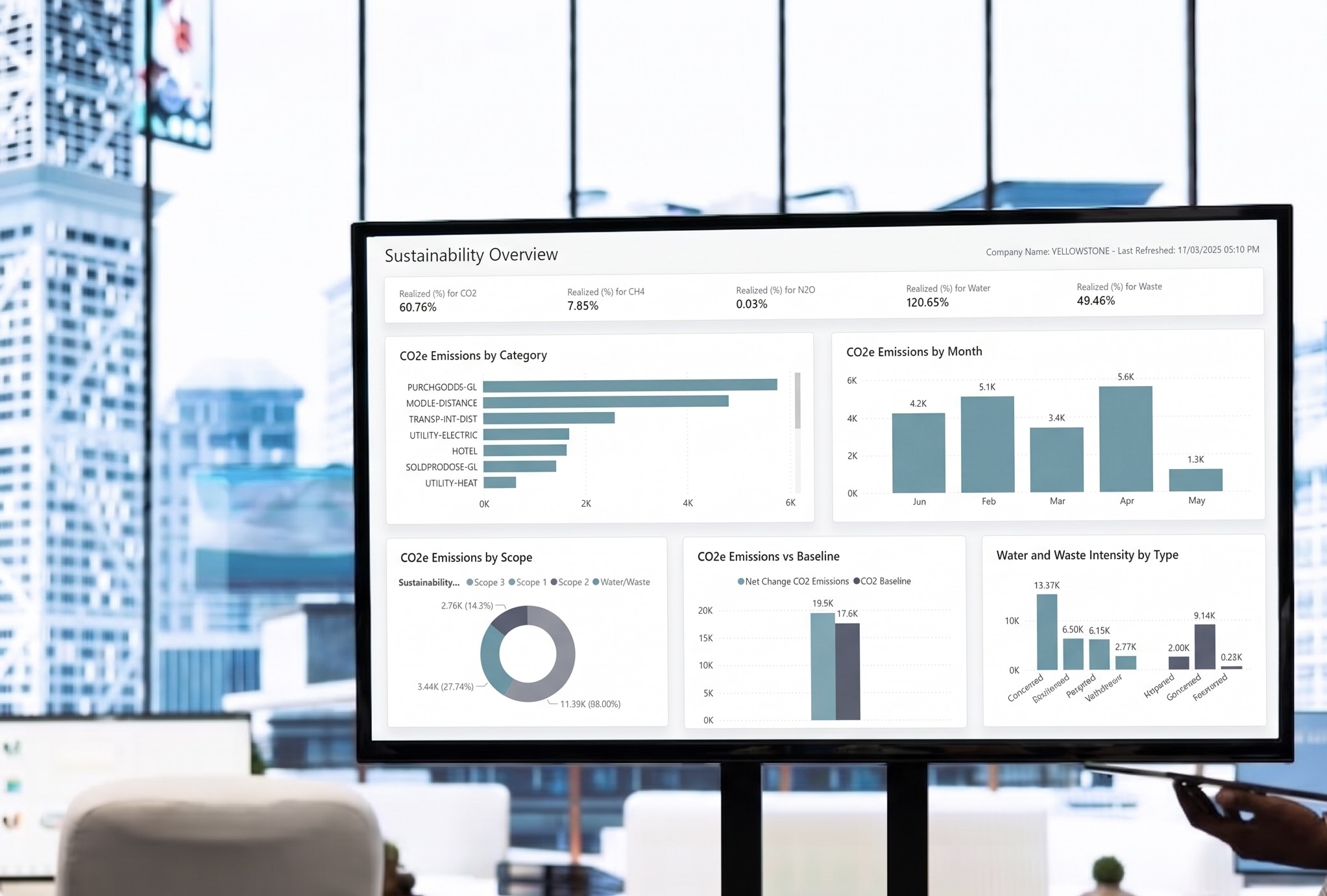
Reporting tools built around Business Central, including Power BI, give distribution businesses live dashboards across stock, margin, currency exposure and supplier performance, without the monthly rebuild. That's the difference between finding out about a margin problem at month-end and catching it while there's still time to act.
There's also a headcount cost to the old way of doing things. Businesses that rely on manual reporting tend to add finance staff as they grow, simply to keep the spreadsheets running, rather than adding capacity where it's actually needed. Moving reporting into the ERP itself doesn't just improve accuracy, it frees up finance time that's currently spent rebuilding the same reports every month.
The businesses that get the most from Business Central in distribution aren't the ones that simply migrate their existing spreadsheets into a new system. They're the ones that use the move as a chance to properly design multi-warehouse structures, landed cost rules and currency handling around how the business actually operates.
That's where a Business Central implementation built specifically around distribution, rather than a generic finance-only rollout, makes the difference. Warehouse structure, import processes and supplier currency arrangements all need to be mapped properly before go-live, not adjusted afterwards.
If your distribution business is spending more time reconciling spreadsheets than running the warehouse, it's worth a conversation. Speak to the Creative Computing team about what a distribution-sector Business Central implementation would look like for your business.

.jpg)

.jpeg)
.png)
.jpg)
.png)
.png)

.png)